
When repairing plastic, choosing the right adhesive makes the difference between a solid fix and a quick failure. Two top contenders are epoxy glue and cyanoacrylate (super glue)—both commonly used for toys, car parts, and broken gadgets.
Epoxy vs super glue for plastic, which one performs better?
This guide compares bond strength, durability, plastic compatibility, and real-world use cases, helping you decide which adhesive works best for your needs.
Which Glue Performs Better on Plastic Surfaces?
Both epoxy glue and cyanoacrylate (super glue) are common plastic and metal bonding adhesives. However, performance varies based on plastic type, bonding strength, and application environment.
- Epoxy glue forms a strong, durable bond with thermoplastics.
- Cyanoacrylate sets quickly and works best on smooth, non-porous plastics.
Plastic repairs require more than quick adhesion. Factors like ABS compatibility, tensile strength, curing time, and flex resistance matter.
How Do Epoxy and Super Glue React to Different Plastics?
Plastic types vary in surface energy and porosity. This affects adhesive compatibility.
| Plastic Type | Epoxy Performance | Cyanoacrylate Performance |
|---|---|---|
| ABS (Acrylonitrile Butadiene Styrene) | Strong bond with prep | Fast grip, brittle under stress |
| PVC | Reliable with surface prep | Weaker long-term adhesion |
| Polycarbonate | Excellent resistance | Poor durability |
| Polyethylene (PE) / Polypropylene (PP) | Requires primer or flame treatment | Very weak bond |
Epoxy bonds better to high-performance plastics.
Cyanoacrylate often fails on low-energy plastics without primers.
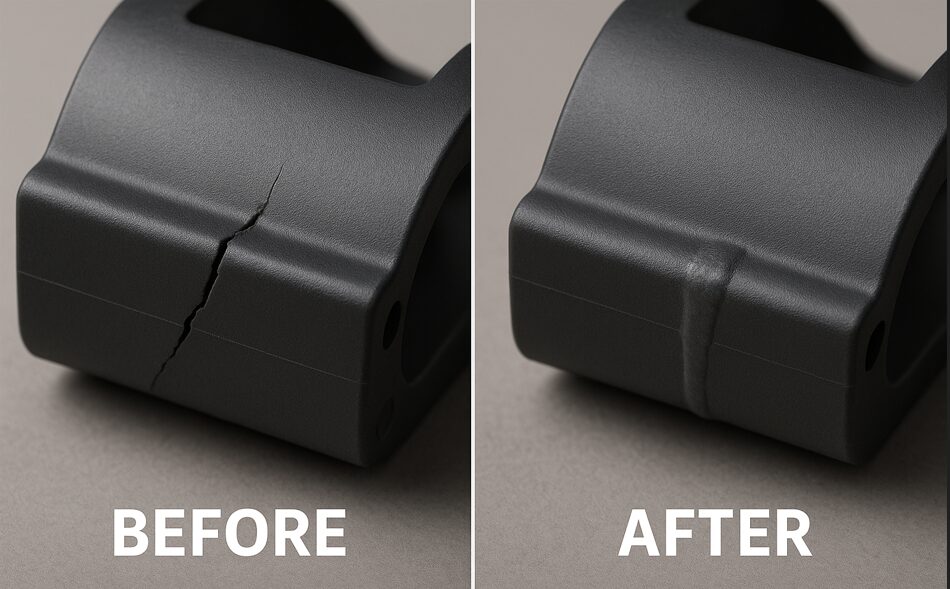
How Does Bond Strength Compare Between Epoxy and Super Glue?
Epoxy glue – produces high shear and peel strength
Cyanoacrylate – provides quick initial hold but low long-term resilience
- Epoxy offers 3000+ PSI bonding strength on ABS when mixed and cured properly.
- Cyanoacrylate can bond quickly (~1000 PSI), but it’s brittle under vibration or impact.
Example:
A cracked ABS toy repaired with epoxy withstands drops better than one fixed with super glue.
What About Cure Time and Application Complexity?
| Attribute | Epoxy | Cyanoacrylate |
|---|---|---|
| Cure Time | 5–24 hours | 5–60 seconds |
| Surface Prep | Required (clean + roughen) | Minimal (clean only) |
| Application | Two-part mix | Single-component tube |
| Gap-Filling | Excellent | Poor |
| Shelf Life | Long (unmixed) | Short (after opening) |
Epoxy requires mixing and longer curing but performs better structurally.
Cyanoacrylate is ideal for quick fixes where mechanical strength isn’t crucial.
Which Glue Is Best for ABS Repair?
ABS plastic is commonly found in:
- Car dashboards
- Game controllers
- Power tool casings
- LEGO bricks
Epoxy resin is preferred for ABS repairs due to:
- Better gap-filling on fractured edges
- Resistance to thermal expansion
- Long-term bond integrity
Cyanoacrylate, while fast, may become brittle with temperature shifts or pressure.
Expert Tip: Score and roughen ABS surfaces with 400-grit sandpaper before applying epoxy.
What Are Use Case Scenarios?
Use Epoxy If:
- The part faces mechanical stress or heat
- You need to fill cracks or gaps
- You’re repairing structural plastic like ABS or PVC
Use Cyanoacrylate If:
- The fix is cosmetic or temporary
- Speed is essential
- The plastic is rigid and smooth
Final Words: Which Adhesive Should You Use?
For high-stress, long-lasting plastic repairs—especially on ABS, PVC, or polycarbonate, epoxy glue is more reliable. It offers superior gap-filling, chemical resistance, and structural bonding.
If speed matters and the fix is temporary or cosmetic, cyanoacrylate is faster but less durable.
Frequently Asked Questions (FAQs)
Is epoxy glue stronger than super glue on plastic?
Yes. Epoxy creates a more durable, long-lasting bond on most plastics than cyanoacrylate.
Can super glue fix broken plastic toys?
Yes, but only for clean breaks. Epoxy is better for toys that need strength.
How long does epoxy take to bond plastic?
Epoxy sets in 5 minutes to 1 hour and cures fully in 24 hours.
Does epoxy work on ABS plastic?
Yes. Epoxy forms a high-strength bond on ABS with surface preparation.
Which glue is waterproof for plastic repairs?
Epoxy resists water and chemicals better than cyanoacrylate.